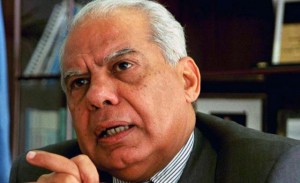
“The government will not backtrack on a free market economy,” said Hazem al-Beblawi, who is also the interim government’s finance minister. AGENCIES
Egypt’s government is looking at ways to reduce its dependence on borrowing from local banks because it is a burden on the economy, the finance minister said on Sunday. “The government is considering ways to decrease reliance on internal funding because it constitutes a burden on the economy and is a temptation for banks to abandon their original role in funding the private sector,” Minister Hazem el-Beblawi said. He said the government could not continue with Egypt’s costly subsidy regime that lowers prices for consumers and industry and changes were needed within two or three years. “We want to start with things that are less harmful to the consumer,” Beblawi told reporters. “People must get used to the idea that the subsidy is an exception.” Free Market Beblawi also said that his country was committed to a free market economy, after the ownership of three companies was returned to the state, sparking fears among investors. “The government will not backtrack on a free market economy,” said Hazem al-Beblawi, who is also the interim government’s finance minister. On September 21, the Cairo Administrative Court suspended the privatization contracts of three companies, returning them to the public sector. The sale of the companies ̶ Shebin Textile Company, Tanta Linens and Al-Nasr for Steam Boilers ̶ had been contested in court by the Egyptian Centre for Economic and Social Rights (ECESR). The ECESR had argued that the companies were sold illegally under the ousted regime of Hosni Mubarak for prices far lower than their real value. The September court ruling raised fears among foreign investors that Egypt was heading towards a policy of nationalization. . Beblawi told reporters that the government “respects all its previous agreements and contracts with the private sector, as long as the deals were conducted within the law.” He said that the January 25 uprising ̶ which toppled Mubarak in February ̶ “worked to restore Egypt as a country of law, so all the court rulings will be implemented.” “This is the first step in restoring trust in Egypt’s investment climate,” Beblawi said. The country’s political and economic outlook has been mired in uncertainty since Mubarak was ousted and power passed to the Supreme Council of the Armed Forces (SCAF), which is led by Mubarak’s long-time defence minister. Heightened frustration at the military rulers’ handling of the transition has led to protests, strikes and sporadic clashes. Last week SCAF laid out the timetable for the first post-Mubarak parliamentary elections which will start on November 28 and take place over four months.

