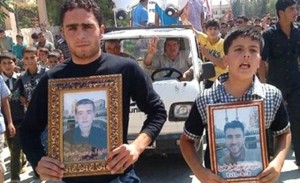
The Syrian Human Rights Organization Sawasiah said at least 113 civilians were killed last week in military raids and in gunfire aimed at protesters, including a family of five in Homs. Alarabiya – Agencies
Syrian forces stepped up raids across the country to arrest activists on Sunday after one of the bloodiest weeks in the six-month uprising against President Bashar al-Assad, residents and activists said. Dozens of people were seized in house-to-house raids in the eastern tribal province of Deir al-Zor, in the southern Hauran Plain and in villages around the city of Hama, which was among the hardest hit by armored assaults on protest flashpoints. A lawyer from the southern city of Deraa, the cradle of the revolt against 41 years of Assad family rule, said he saw dozens of troops encircling the nearby village of Yadouda. “I saw them by accident and fled. I heard that they later went into houses. They can come at any minute and raid and arrest,” the lawyer, who asked not to be named, said by phone. He said detainees could expect ill-treatment or worse. “You either disappear and are never heard from again, come back red and blue with holes in your body from beatings and torture to make an example of you or simply return in a coffin.” Woman, teenager killed A woman was shot dead in eastern Syria on Sunday and a teenager died of wounds suffered at a funeral in the capital Damascus on Saturday, the Syrian Observatory for Human Rights said. “A 40-year-old woman was killed at noon on Sunday by a stray bullet as security forces were tracking wanted people in the town of Bukamal,” AFP cited an activist in Deir Ezzor province as saying. The Observatory also told AFP in Nicosia that a youth had died of wounds received on Saturday when security forces opened fire on mourners at the funeral of an activist in Daraya, near Damascus. “A 17-year-old succumbed to his wounds on Sunday after security forces the day before fired on a crowd at the funeral of Ghiyath Matar,” it said. Syrian authorities do not comment on arrests or allegations of torture but have said in the past that any arrests are made in accordance with the constitution. They say they are fighting armed gangs who have killed at least 500 security personnel. The United Nations says 2,200 people have died in the uprising that erupted in mid-March, while a Syrian grassroots organization says security forces have killed 3,000 civilians. Syria has banned most independent journalists, making it hard to verify accounts of the violence from either side. The Syrian Human Rights Organization Sawasiah said at least 113 civilians were killed last week in military raids and in gunfire aimed at protesters, including a family of five in Homs. Meanwhile, Syria has repeatedly blocked United Nations requests to admit human rights monitors, said a UN official who stressed that regional bodies such as the Arab League are key to reaching a long-term political solution to the crisis. UN humanitarian affairs chief Valerie Amos said the organization had made clear it was “extremely concerned” about reports of human rights violations, but that the Syrian government had denied entry to rights investigators. “The requests have repeatedly been made for a human rights mission into Syria. It hasn’t yet happened but they have been made repeatedly,” Amos told Reuters in an interview. She added that a UN mission entered Syria last month but with only limited access. Arab League Arab League chief Nabil al-Arabi met Assad on Saturday with a 13-point document outlining Arab proposals to broker an end to the bloodshed, hold elections and push for reforms. During his talks with Assad, Arabi said the League and other Arab countries “reject any form of foreign interference in Syrian domestic affairs,” the official news agency SANA reported. Arabi said upon returning to Cairo that they had reached an “agreement on steps to carry out the reforms, (and) the elements will be submitted to the council of the Arab League” in Cairo on Monday. SANA reported Assad as saying that there was a need “to not get caught in campaigns of disinformation against Syria.” It said he denounced the campaign of spreading “wrong facts” aimed in his opinion “to harm the image of Syria and destabilize” the country.

