

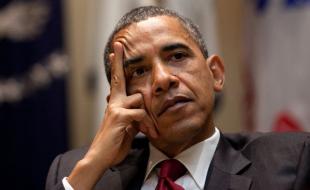
Barack Obama listened to his children, listened to the Bible, listened to his wife Michelle, listened to his political advisers- and joined Vice President Joe Biden in endorsing same-sex “marriage”.
Obama and his supporters have taken two mutually contradictory approaches to the president’s decision. One approach taken by Obama is to spin the decision as a latter-day “profile in courage”. Obama thus claimed he did what was right even as he himself conceded that this could hurt him politically.
The other approach is that Obama’s position will carry political rewards. It will fire up his political base and particularly the young, who adopt the coolest attitudes (in both senses of the word) to traditional marriage.
It could also deflect the Republicans into dropping the economic issue, where Obama is the most vulnerable, and taking up the cudgels of the social issue in a manner that will alienate moderates and independents.
Obama, say the political optimists, has not lost contact with the American public that is increasingly moving to support or at least accept such unions as inevitable.
The New Republic, in an editorial, tries to split the difference between the two approaches: “Obama is probably a mild favorite, he really doesn’t have a political incentive to take dramatic risks. And this was a certainly a risk—maybe not an unduly reckless one, but a risk all the same. So give Obama credit for taking a principled stand that wasn’t necessarily in his political interest.”
One can offer a different take on the decision that appears to fit this presidential race and the current rivalry between the two parties.
The parties are poles apart on an entire range of issues: Does one reduce deficits by taxation (Democrats) or by budget-cutting (Republicans), a citizenship path for illegal immigrants (Democrats) or a severe crackdown on illegal immigration (Republicans), protect government civil service unions (Democrats) or curb the bargaining power of civil service unions (Republicans) regard global warming as an existential threat requiring drastic action (Democrats), or treating global warming as overhyped or even fraudulent (Republicans).
Not only are the parties divided on the issues, but each tends to believe that it represents the majority of the American people. As blue Democratic states get bluer and red Republican states get redder, this creates an echo chamber tendency where both parties are convinced that they represent vox populi, the popular will, on each particular issue. Same-sex “marriage” just adds another issue to the divisive list.
In an election campaign, one tries to achieve a proper trade-off between wooing floating voters in the center and mobilizing the base. Given an enthusiasm gap that was working in favor of the Republicans, the Democrats, at least at this stage, have to tilt towards mobilization.