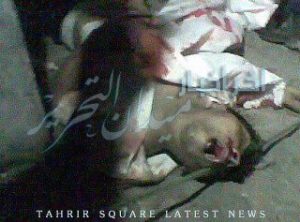
The report comes after three days of violent clashes between security forces and protesters demanding a swift military exit from power and the withdrawal of a draft law seeking to shield the military establishment from parliamentary oversight AL ARABIYA
Amnesty International on Tuesday accused Egypt’s military rulers of having “completely failed” to fulfill their promises to protect human rights and of having committed human rights abuses worse than those committed by the ousted regime of Hosni Mubarak. In “Broken Promises: Egypt’s Military Rulers Erode Human Rights,” Amnesty accused Egypt’s Supreme Council of the Armed Forces (SCAF) of having “continued the tradition of repressive rule,” which the January revolution sought to eliminate. “Military courts have imprisoned thousands of civilians. Military prosecutors have summonsed, interrogated and ordered the detention of those who criticize the army. Military forces have used unnecessary or excessive force to disperse demonstrations. The euphoria of the uprising has been replaced by fears that one repressive rule has simply been replaced with another,” Amnesty said in the report released Tuesday. Amnesty reported that nearly 12,000 went through “grossly unfair trials” in military courts from the period when the armed forces were deployed in late January until August. At least 13 have been sentenced to death, according to the report. Amnesty reported that defendants were charged with “thuggery,” “breaking the curfew,” “damaging property” and “insulting the army.” In April 10, Egyptian activist and blogger Maikel Nabil Sanad, 26, was handed a three-year prison sentence by a military court following his criticism of the army’s use of force against demonstrators in Cairo’s Tahrir Square and his objection to serve in the military. “By using military courts to try thousands of civilians, cracking down on peaceful protest and expanding the remit of Mubarak’s emergency law, the SCAF has continued the tradition of repressive rule which the Jan. 25 demonstrators fought so hard to get rid of,” said Philip Luther, Amnesty International’s Middle East and North Africa Acting Director, in comments posted on Amnesty’s website. The report comes after three days of violent clashes between security forces and protesters demanding a swift military exit from power and the withdrawal of a draft law seeking to shield the military establishment from parliamentary oversight. The Amnesty report also accused the Supreme Council of Armed Forces (SCAF) of attempting to crackdown on independent journalism, leading to the cancellation of several current affairs broadcast shows being cancelled or indefinitely postponed. The report noted that in late March, “a letter purportedly from the armed forces’ department of Morale Affairs was circulated on the Internet…apparently contained instructions not to publish information about the armed forces without first consulting the departments of Morale Affairs and Military Intelligence.” “Those who have challenged or criticized the military council – like demonstrators, journalists, bloggers, striking workers – have been ruthlessly suppressed, in an attempt at silencing their voices,” Amnesty’s MENA Acting Director, Luther, added. “The human rights balance sheet for SCAF shows that after nine months in charge of Egypt, the aims and aspirations of the Jan. 25 revolution have been crushed,” Luther urged Egypt’s ruling generals to lift their grips of the freedom of expression and strop trying civilians in military courts if there should be any “effective transition to the new Egypt.

