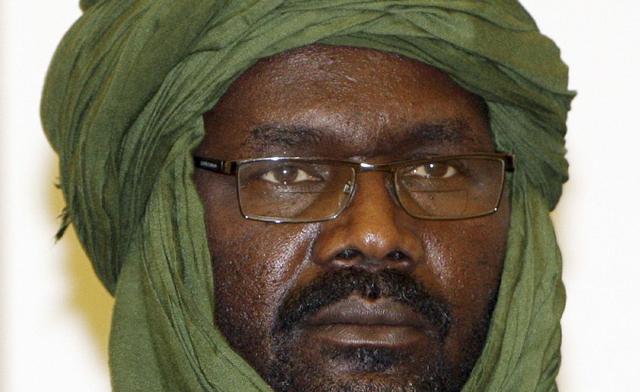
“The Sudanese army announces that they killed Khalil Ibrahim in fighting today west of Wadbanda in North Kordofan,” the official Sudan News Agency (SUNA) said. AL ARABIYA – AFP
Sudan’s army killed a key rebel leader and 30 of his Darfur-based troops in a battle which was still continuing on Sunday, officials said, after rebels announced an advance towards the capital. “The Sudanese army announces that they killed Khalil Ibrahim in fighting today west of Wadbanda in North Kordofan,” the official Sudan News Agency (SUNA) said. But the confirmation from the rebel group that their leader has been killed in clashes with government forces came only late Sunday “We, the Justice and Equality Movement, announce to the Sudanese nation that the leader of the movement and the commander of its troops, Khalil Ibrahim Mohammed, was killed on December 23 at 3:00 am,” London-based rebel spokesman Gibril Adam Bilal told AFP. Ibrahim headed the Justice and Equality Movement, the most heavily armed group in the Darfur region. Ibrahim’s death, if confirmed, could represent a serious blow to the rebel group, although tightly restricted access to Darfur and Sudan’s other conflict zones makes it almost impossible to accurately gauge the real strength and internal unity of insurgent groups. The armed forces spokesman said Ibrahim and other leaders had been trying to enter South Sudan, which seceded from Sudan in July under a 2005 peace deal that ended a separate, decades-long civil war. JEM could not immediately be reached for comment. Mainly non-Arab insurgents in Darfur took up arms against Khartoum in 2003, claiming the central government had neglected the remote region and was favoring local Arab tribes. On Friday, Sudanese army spokesman Saad claimed JEM “attacked civilians” and targeted local leaders while looting their property as they advanced to Khartoum. In 2008, more than 222 people were killed when JEM guerrillas drove about 1,000 kilometers across the desert to Omdurman, just over the River Nile from the presidential palace on the Khartoum side. Government troops repulsed them after heavy clashes and later sentenced dozens of rebels to death for their role in the assault. In July, the government signed the Doha Document for Peace in Darfur with the Liberation and Justice Movement, an alliance of rebel splinter factions. Darfur’s main armed groups ─ JEM and factions of the Sudan Liberation Army headed by Minni Minnawi and Abdul Wahid Nur ─ did not sign the deal. Instead, last month they, along with the SPLM-North rebel group, ratified documents forming the new Sudanese Revolutionary Front dedicated to “popular uprising and armed rebellion” against the National Congress Party regime in Khartoum. According to the United Nations at least 300,000 people have been killed in Darfur since 2003 when fighting broke out between non-Arab rebels and the Arab-dominated Khartoum regime. The government puts the death toll at 10,000. U.N. officials say 1.9 million people are internally displaced and still living in camps in Darfur, with about 80,000 newly displaced by fighting this year. Six people including President Bashir are being sought or are before the Hague-based International Criminal Court for crimes allegedly committed in the Darfur region. What is the Justice and Equality Movement? The Islamist-inspired JEM is a Darfur-based rebel movement with an agenda for national reform. It was the best equipped and politically savvy of Darfur’s rebel groups but lacked the broad ethnic base of other tribal-based movements, and its recent troop strength remains unclear. Their movement emerged in the country’s western Darfur region in 2003, when rebels from the main Sudan Liberation Movement first rose up. At the time, it reportedly had no more than 100 fighters. JEM’s ideological roots as a national movement lie with the National Islamic Front (NIF) which, under the leadership of Hassan Turabi, backed a bloodless coup that brought President Omar al-Bashir to power in Khartoum in 1989. Ibrahim initially supported the NIF but became disillusioned with what he saw as its economic neglect of Sudanese regions. He set up a group of dissidents called “The Seekers of Truth and Justice” and published the “Black Book” in 2000 which detailed Arab domination of Sudanese political power and natural resources. Exiled to the Netherlands, Ibrahim announced the formation of the Justice and Equality Movement, whose core support was limited to the Kobe sub-branch of the non-Arab Zaghawa group, which straddles western Sudan and eastern Chad. Its experience with the NIF gave it political experience other Darfur rebel groups lacked. “JEM’s greater political and communications savvy allowed the JEM to punch well above its military weight,” the Small Arms Survey said in an earlier report. “But it is a puzzling and sometimes contradictory movement.” Some JEM military leaders broke away in 2004 to form the National Movement for Reform and Development. Another JEM faction led by Mohammed Saleh Harba emerged in 2005. The JEM’s agenda for national reform well beyond Darfur led to its involvement in Sudan’s eastern rebellion, which ended with a peace deal between the Eastern Front and Khartoum in 2006. In the east, JEM rebels acquired a reputation for effective hit-and-run attacks on isolated Sudanese army forces, often attacking under cover of sandstorms that prevented government helicopter gunships from responding. Sudan accused Chad of supplying and equipping the JEM, including for its unprecedented march on Khartoum in May 2008. The rebels reached the capital and were repulsed with heavy casualties, but the brazen attack shocked the Khartoum regime. The JEM also carried its characteristic hit-and-run attacks to foreign oil installations in Kordofan, to the east of Darfur. Three days before the report of Ibrahim’s death, JEM’s London-based spokesman announced that the group’s forces had moved into North Kordofan and were advancing eastwards towards the capital again, on a mission to topple the Bashir regime. The International Crisis Group of analysts has said that the JEM’s perceived Sudan-wide and Islamist agenda made it suspect among many Darfuris, but it stuck to its demands. In July, the government signed the Doha Document for Peace in Darfur with the Liberation and Justice Movement, an alliance of rebel splinter factions. Ibrahim’s return to Darfur Ibrahim was living in exile in Chad until 2010 when he was expelled after Chad’s rapprochement with Sudan. He sought refuge in Libya but in September, he fled after Muammar Qaddafi’s government was ousted. Sudan had accused Ibrahim’s forces of fighting for Qaddafi in his attempt to hold on to power. Upon his return in an email interview with AFP, he said “I have returned to my country to fight for the rights of the people in all regions of Sudan … and to put in place a program for the next stage in the resistance to this despotic regime.” He also said he was in communication with “all the (rebel) parties … and we are trying to coordinate an alliance with them to overthrow this regime.” Since Ibrahim’s return in September, a new conflict had opened up on Sudan’s border with the newly independent south, in Blue Nile state, between the army and opposition party turned rebel group the SPLM-North, which is also battling government troops in nearby South Kordofan. The SPLM-North met leaders of the three main Darfuri rebel groups in early August, including a senior JEM representative, to form a new alliance aimed at bringing about regime change in Sudan through the use of force and popular uprising. Ibrahim confirmed to AFP that his movement had been fighting alongside the SPLM-North in South Kordofan and said they also had a presence in eastern Sudan, where a decade-long rebellion against Khartoum ended with a fragile peace agreement in 2006. Asked why JEM refused to sign the Doha peace document with the government in July, despite being the only major armed group to attend the Qatar-brokered negotiations, the rebel leader said to AFP that it did not tackle the “key disputed issues” or respond to the “urgent demands” of Darfuris. The disputed issues he accused the government of failing to resolve include the imbalance of power and wealth in Sudan, impunity for those responsible for crimes in Darfur, and the problem of displaced people, refugees and nomads. “The document did not put a limit on the excesses of the government, which violates fundamental freedoms and human rights,” he said.

