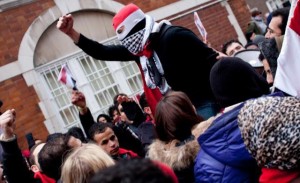
“Many Egyptians thought it would only be a few months and their salaries would be better and they would have a better quality of life, but that is not realistic.” EMAN EL-SHENAWI – AL ARABIYA
To many Egyptians living outside of their home country, missing out on the revolutionary thrill in Egypt may have seemed like they were missing out on one big party. But as the unrest lingers and the country fails to regain stability, the fun may have turned slightly sour for Egyptians abroad. When the first flickers of protests broke out across Egypt, in late January of this year, Egyptians from all over the world flocked to Tahrir Square, the heart of the anti-government demonstrations, to be on the ground and take part in a cause they championed. The goal back then was to get rid of President Hosni Mubarak, largely thought to have tarnished the country on many fronts throughout his 30 years of autocratic rule. Now, as the country’s bustling revolutionary pace steadies, the roars once heard by Egyptians protesting both at home and abroad may now have been reduced to a subtler hush. Amany Abbas, an Egyptian who has lived in London for 11 years, traveled to Egypt on January 28 of this year, when the protests began to peak and the government backlash began. “I experienced the most frightening days of my life in those few weeks. But it was all worth it, I was prepared to die for Egypt,” she says. “I felt proud to be there when Hosni Mubarak fell. Going back to London and telling friends and strangers from different nationalities about my experience in Egypt made me realize how much everyone was also proud of what we achieved.” But now, Amany says that she, like many of her Egyptian friends, is suffering from post-revolution blues. Despite the criminal trials of the former president and members of his deposed regime currently under way – a big indicator of justice and reform – the country is lacking the political substance needed for a new Egypt to take shape. The upcoming elections – reportedly proposed by Egypt’s election committee chief to be held in November – remain a blurred subject, as protesters in Egypt have more recently begun criticizing their transitional leaders. Many Egyptians accuse the Supreme Council of the Armed Forces (SCAF) and the transitional government of dragging its feet in preparations for a transition to democracy, with some fearing that the council was hesitant about handing power to civilians. To muddle the situation, Egypt has also been dealing with a diplomatic scuffle with Israel in recent weeks after Israeli military forces killed Egyptian border guards, is facing volatile political talk about the peace treaty between the two countries and been home to further protests, this time against Israel and its embassy in Cairo. “It’s like Egypt does not want to catch its breath and focus on Egypt’s real problems. Protesters are busying themselves with sideline issues that can be dealt with later. There is no political or societal resolve,” says Amany, referring to the transitional military leaders, the protesters and the current government. “It’s embarrassing,” she says, “People had been congratulating me just a few months ago about our revolution, but now it seems that there are a million loose ends that Egypt has to deal with before it can move forward.” About 69 percent of Egyptians believe the trials of former members of Mubarak’s cabinet are proceeding too slowly, a recent government poll revealed. This is despite the sentencing of former ministers and regime figures coming thick and fast over recent weeks. In another poll carried out by the International Republican Institute, Egyptians said they were pessimistic about the future of Egypt’s economy, which has largely hurdled into free-fall since January, with 81 percent saying it is a “bad time to find a job.” “Most people in Egypt are no longer supporting the revolution as they were in January,” says Khaled Fahmy, an Egyptian software consultant in London who travelled to Egypt during the protests and frequently spoke to the media about his thoughts on the uprising after his avid tweeting and social media updates. “Many Egyptians thought it would only be a few months and their salaries would be better and they would have a better quality of life, but that is not realistic.” Khaled still supports the revolution, and flew to Egypt recently to attend the Tahrir Square Sept. 9 mass protest against the military council. There, he better understood Egyptian attitudes. “They are disappointed with the SCAF, but they are unwilling to realize that real change takes time and effort and I think they are not keen on that,” he says. Khaled believes that any reforms being made must be better organized. “If Egypt’s leaders rush reforms, we will end up with a ready-made constitution that won’t lead us to true democracy but to autocracy similar to the previous regime.” Meanwhile, in London, Khaled says that many Egyptians are disappointed with how demonstrators in Egypt are using the method of protests or sit-ins to dispute anything and everything. “They should realize that they have to make some compromises on their demands,” he said. He also says that Egyptians abroad are concerned with their right to vote in elections, which was one of the major initial demands of the revolution. “So far, we don’t know if the SCAF will allow us to participate in the vote. If we’re not allowed it will be a big shame after a big revolution,” he explained.

