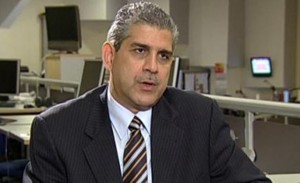
“The reality is that USA give us the money not as charity, but because it is in the best interest of the U.S. in the region. And if members of Congress don’t understand that . . . then that’s their problem.” , Ma’an Erekat said. MUNA SHIKAKI – ANGELA SIMAAN – AL ARABIYA
The Palestinian Liberation Organization’s representative to the United States told Al Arabiya on Thursday that highly charged comments attributed to him by an American newspaper were misleading and slanderous, and one more struggle in the uphill climb for recognition at the United Nations. USA Today, the most widely circulated newspaper in the U.S., accused Ma’an Erekat of calling for a future Palestinian state “empty of Jews,” and in the same stroke, quoted a former Bush official who accused Erekat of anti-Semitism. In an on-the-record briefing with journalists, Erekat had said: “after the experience of the last 44 years of military occupation and all the conflict and friction, I think it would be in the best interest of the two people to be separated.” Erekat said he was referring to a separation between Israelis and Palestinians, not a separation based on religion. Elliot Abrams, Bush’s Deputy National Security Advisor, told USA Today that such a state would be the first to officially prohibit Jews or any other faith since Nazi Germany. In a Congressional hearing on Wednesday, Abrams was also one of the increasing number of people calling for the closure of the PLO office in Washington. The Israeli press quickly picked up the controversy, and Israel’s foreign minister Avigdor Lieberman released a statement shortly after saying he had instructed the foreign ministry to submit formal complaints to the European Union and the United States concerning Erekat’s alleged remarks. Erekat told Al Arabiya that USA Today’s article injected a tone of anti-Semitism into his remarks that was not in the original transcript, and described the controversy as another attack in the sustained campaign against the Palestinians. “This pressure is the same pressure we face continuously from the same circles,” Erekat said, referring to Abram’s remarks, “and (pro-Israeli activists) are taking advantage of the situation to add to the pressure before we go to the United Nations General Assembly.” The firestorm comes at a time when the Palestinians are facing increased pressure from the U.S. administration and Congress to withdraw their bid for membership at the U.N. The U.N. General Assembly meets on Sept. 23, and the Palestinians have indicated they are still planning to seek recognition at the Security Council. In recent months the U.S. House of Representatives responded by introducing at least two pieces of legislation that would cut off funding to the Palestinian Authority as punishment for both the U.N. move and for reconciling with Hamas. However, US State Department spokesperson Mark Toner said on Friday that the U.S. government plans to continue funding the PA. The U.S. President has the authority under a national security clause to bypass Congressional restrictions on foreign aid, but the Republican majority in the House is looking to further restrict the waiver or remove it all together, which would present yet another roadblock to President Barack Obama’s policies. Some experts say the impending congressional and presidential elections next year are making it harder for Palestine’s allies in the U.S. government and Congress to use political capital to defend aid to Palestine. “The question is, if the Palestinians had approached the U.N. a year and a half from now, after the elections, would the U.S. have threatened to veto?” said Steve Clemons, Washington editor-at-large of The Atlantic magazine. “The reality is that Jewish American votes are vital in these elections.” Erekat, however, doubts the U.S. will stop funding the PA. “The reality is that they give us the money not as charity, but because it is in the best interest of the U.S. in the region. And if members of Congress don’t understand that . . . then that’s their problem.”

