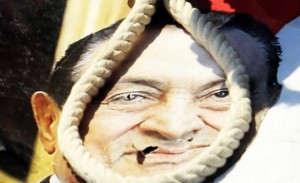
Mubarak, who ruled Egypt for 30 years, is the first Arab leader to stand trial in person since popular uprisings swept the Middle East this year. REUTERS
An Egyptian court started the third session of the trial of ousted President Hosni Mubarak on Monday when senior police officers are expected to become the first witnesses to give testimony, a witness at the court reported. Mubarak, who has been hospitalized since April, arrived at the site of a court in Cairo by helicopter where he will attend the third session of his trial, state television reported. The trial is to be held off-camera unlike the first two sessions which saw the 83-year-old Mubarak appearing in court bound to a stretcher and caged, in gripping images that were broadcast live on television. The decision to stop the live television broadcast was taken by trial judge Ahmed Refaat, who was apparently exasperated by the charged atmosphere in the courtroom at the last hearing as an army of lawyers jostled for position. Mubarak’s dramatic appearance in court came as a shock to Egyptians who were glued to watching the proceedings on television, never having believed he would be forced to go on trial. Mubarak, who ruled Egypt for 30 years, is the first Arab leader to stand trial in person since popular uprisings swept the Middle East this year. Outside the Police Academy on Cairo’s outskirts where the trial is being held, about 150 Mubarak supporters held up posters of the ousted president chanting: “He gave us 30 years of protection, Mubarak hold your head up high.” Nearby, anti-Mubarak protesters hurled stones at police and some officers threw rocks back. “He has to be hanged. We don’t want any more delays in the court session,” said Mohamed Essam, who travelled from the Nile Delta town of Kafr el-Sheikh. Scuffles between the two groups of demonstrators and police also erupted during two previous sessions. “We are expecting to hear the testimony of four witnesses that the prosecution has asked to prove the charges against Mubarak and the others,” said Gamal Eid, a lawyer representing 16 of the roughly 850 people killed in the uprising that ended his rule. Mubarak is charged with involvement in the killing of the protesters. Eid said one of the witnesses is a top police officer, General Hussein Saeed Mohamed Mursi, who worked in the force’s operations room during the uprising. The three other witnesses called by the court are police officers who were in the operations room during the 18 days of protests. The court named them as Emad Badr Saeed, Bassim Mohamed el-Otaify and Mahmoud Galal Abdel Hamid. Mubarak is standing trial with his sons Gamal, once viewed as being groomed for the top office, and Alaa, as well as former Interior Minister Habib al-Adli and six police officers. Those found guilty for the deaths of the protesters could face execution. Ten Kuwaiti lawyers are expected to join the defense team for Mubarak on Monday. Some of the lawyers said their role comes as a gesture of gratitude to Mubarak for his support for a US-led coalition that expelled Iraq from Kuwait in 1991. A news conference held by the Kuwaiti lawyers on Sunday descended into chaos when backers of Mubarak attacked a journalist, scratching his arms and beating him after he asked why the Kuwaitis were defending the ousted president. Tunisia’s ex-president Zine el Abidine Ben Ali, in exile in Saudi Arabia since his overthrow in January, was tried in absentia in Tunisia, while Libya’s Muammar Qaddafi has become a fugitive since the fall of Tripoli late last month. Legal experts say a thorough probe of Mubarak’s alleged crimes should have taken several more months, but Egypt’s ruling military to which he handed power and the government has expedited the process to mollify protesters.

