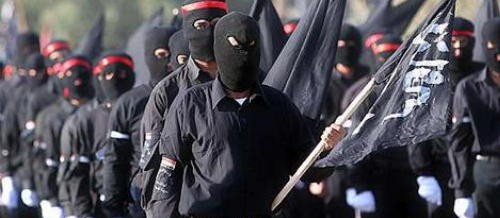
the question remains: Does Bin Ladenism or Salafism or whatever we agree to call it have anything in common with fascism?
britishfreedom The late Christopher Hitchens argued that ‘Islamofascism’ is a valid term: The term Islamofascism was first used in 1990 in Britain’s Independent newspaper by Scottish writer Malise Ruthven, who was writing about the way in which traditional Arab dictatorships used religious appeals in order to stay in power. I didn’t know about this when I employed the term “fascism with an Islamic face” to describe the attack on civil society on Sept. 11, 2001, and to ridicule those who presented the attack as some kind of liberation theology in action. …the question remains: Does Bin Ladenism or Salafism or whatever we agree to call it have anything in common with fascism? I think yes. The most obvious points of comparison would be these: Both movements are based on a cult of murderous violence that exalts death and destruction and despises the life of the mind. (“Death to the intellect! Long live death!” as Gen. Francisco Franco’s sidekick Gonzalo Queipo de Llano so pithily phrased it.) Both are hostile to modernity (except when it comes to the pursuit of weapons), and both are bitterly nostalgic for past empires and lost glories. Both are obsessed with real and imagined “humiliations” and thirsty for revenge. Both are chronically infected with the toxin of anti-Jewish paranoia (interestingly, also, with its milder cousin, anti-Freemason paranoia). Both are inclined to leader worship and to the exclusive stress on the power of one great book. Both have a strong commitment to sexual repression—especially to the repression of any sexual “deviance”—and to its counterparts the subordination of the female and contempt for the feminine. Both despise art and literature as symptoms of degeneracy and decadence; both burn books and destroy museums and treasures. … This makes it permissible, it seems to me, to mention the two phenomena in the same breath and to suggest that they constitute comparable threats to civilization and civilized values. There is one final point of comparison, one that is in some ways encouraging. Both these totalitarian systems of thought evidently suffer from a death wish. It is surely not an accident that both of them stress suicidal tactics and sacrificial ends, just as both of them would obviously rather see the destruction of their own societies than any compromise with infidels or any dilution of the joys of absolute doctrinal orthodoxy. Thus, while we have a duty to oppose and destroy these and any similar totalitarian movements, we can also be fairly sure that they will play an unconscious part in arranging for their own destruction, as well.

