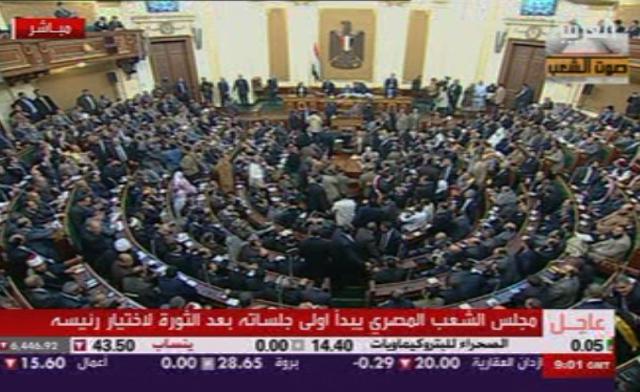
A newly elected Islamist deputy was scolded for adding a religious reference to the swearing-in oath at the opening session of Egypt’s first post-revolution parliament. AL ARABIYA – AGENCIES
New elected members of Egypt’s parliament convened for the first time since the election. (Reuters)
Egypt’s lower house of parliament on Monday helds its first session since a popular uprising ousted veteran president Hosni Mubarak, with Islamists dominating the assembly for the first time. One year after the revolution, many Egyptians see the new parliament as the first sign of democratic rule, in sharp contrast to the toothless legislature that existed under Mubarak. But the exact role of parliament remains unclear, with power remaining in the hands of the military generals who took power when Mubarak resigned last February, according to AFP. “I invite the distinguished assembly to stand and read the fatiha (Muslim prayer) in memory of the martyrs of the Jan. 25 revolution … because the blood of the martyrs is what brought this day,” said Mahmoud al-Saqa, 81, a member of the liberal Wafd party, who as oldest member of the house acted as speaker. After commemorating with the silent prayer, each member read the oath of office. Some wore bright yellow sashes in protest against military trials of civilians. A newly elected Islamist deputy was scolded for adding a religious reference to the swearing-in oath at the opening session of Egypt’s first post-revolution parliament. The deputies started to be sworn in one by one, pledging to “preserve the safety of the nation and the interests of people and to respect the constitution and the law.” But when ultra conservative lawyer Mamdouh Ismail took the microphone vowing to also “abide by the law of God,” he was sharply told off by the chair Mahmoud al-Saqqa — the most senior member of parliament. “Please stick to the text,” an angry Saqqa urged Ismail, asking him to repeat the oath several times.

Muslim Brotherhood symbol
“Mr Ismail, my friend, please stand up and read the oath, and stick to the text,” Saqqa pleaded. Ismail finally agreed, read the oath and then insisted on adding, “and to abide by the law of God.” The rise of the Islamists marks a sea change from Mubarak’s era when parliament was a compliant body stuffed with members of his National Democratic Party and the Muslim Brotherhood was officially banned though semi-tolerated. Youth movements, who put national pride before religion when they galvanized Egyptians in the 18-day revolt against Mubarak, said they would demonstrate outside the assembly to ensure protesters killed in the uprising were not forgotten. “We do not contest the popular mandate of parliament, but it better deliver on the rights of martyrs and wounded. We fear political parties may vie for political gain and ignore the youth,” activist Mohammed Fahmy said, according to Reuters. Liberals were pushed into third place behind the FJP and ultraconservative Islamist Salafis led by al-Nour party, the surprise runners up. The FJP says it controls almost half the 498 elected seats, with a few re-runs still to be held. Although Islamists dominate, it is unclear whether they will form a single bloc in parliament, which will have a key role in drafting the new constitution. The Brotherhood has said it wants to be inclusive and ensure all voices in Egypt are heard. Monday’s session marks the revival of an assembly that in the early 20th century was a vibrant forum for the nation’s aspirations and filled with deputies who vied with the monarch and Egypt’s British overlords. Parliament’s independent voice was extinguished after a 1952 coup that toppled the king and swept military-backed autocrats to power. Mubarak was a former air force commander and the ruling military council is now led by Mubarak’s defense minister for 20 years, Mohammed Hussein Tantawi. “The Egyptian military seems at this point determined to carve out an exception to democratic rule for its area of power and interest,” Human Rights Watch’s executive director Kenneth Roth said on Sunday at the launch of the group’s annual report in Cairo. Parliamentarians see the new assembly as bringing Egypt a step closer to ending military rule. “We say that we respect and appreciate the army but the military council must be held accountable for any mistakes … No one is above accountability,” the Brotherhood’s general guide, Mohammed Badie, said last week. But the Islamist group has also previously said it does not seek a confrontation with the military. Some analysts have suggested the army will not fully abandon politics unless the Brotherhood and other prominent political parties offer guarantees that it will not face legal retribution over the killing of protesters. Mubarak, 83, is now on trial for his role in the deaths of 850 people during the uprising. Scores of people have been killed in sporadic eruptions of violence since then, including demonstrations against army rule in November and December. Several youth groups say they will hold peaceful protests in front of parliament in central Cairo to ensure the new assembly supports those wounded or families of those killed in protests.